It’s mostly about the camera What is a hands on review? Early Verdict A strong phone from Huawei that's well...
It’s mostly about the camera
What is a hands on review?
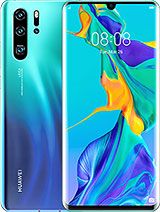
Early Verdict
A strong phone from Huawei that's well put together, but one that lacks any real headline spec beyond the camera. The four sensor array impresses and the zoom is mind-blowing if used correctly - but is that enough for a real flagship?For
- Strong camera
- Mind-bending zoom capabilities
Against
- Specs don't wow
- Screen colors a little muted
Huawei P30 Pro deals
Compare Deals
Amazon Deals

The new Huawei P30 Pro takes a lot of what we saw with the Huawei Mate 20 Pro but improves some elements of the design as well as rebooting the camera somewhat - and is a distinctly more powerful phone than the Huawei P30 in a few ways.
We spent an hour playing with the new phone from the Chinese brand, and while some elements felt a little too familiar, some features of the camera absolutely blew us away.
Huawei P30 Pro price and release date
We had to wait until right until the very end of the launch, but the Huawei P30 Pro price is in: if you're looking for 8GB of RAM, well, you've come to the right place as the P30 Pro only has that spec variant. There are three storage flavors though, and these are: 128GB for €999 (around £850 / $1120 / AU$1500), 256GB for €1099 (around £940 / $1240 / AU$1700) and 512GB for €1249 (around $1050 / $1400 / AU$2000).In terms of the release date for the P30 Pro, you're able to buy it from the date of the launch (March 26) - so if you want it, go grab it. However, it won't be on shop shelves in some territories until a little later - the Huawei P30 Pro UK release date isn't until April 5, for instance.
We're still not expecting these phones to be sold in the US any time soon.
- The best Huawei P30 Pro deals are all listed right here
Design and screen
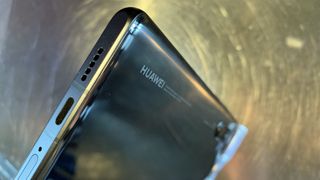
The curved sides taper away nicely in the hand.
The range is pearlescent, and shimmers with different tones rather attractively, apart from black, which is basically so reflective as to be a mirror. We're assuming the name 'Black Mirror' wasn't allowed to be used.
CLOSE
We
weren't given the exact dimensions of the phone in our briefing, but
the 6.47-inch OLED display fits neatly into the front of the phone, with
a small teardrop notch for the camera.

The notch is already seeming a bit outdated on phones - we were surprised to not see a punch-hole.
It's
interesting to hear Huawei call said cut-out 'beautiful' when in
previous briefings we’ve been told how the punch-hole selfie-cam idea is
the future... at least, that's what Huawei’s sister company Honor told
us, and they have the same design team.
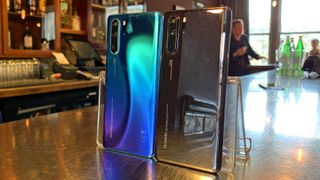
The Aurora and Black colors of the P30 Pro.
The
overall effect of the screen quality is that, despite it being ‘only’
Full HD, you're getting a very impressive picture. The peak brightness
stuns at times, with a bright sunset powering out from a dark scene.
However, we're not sure there's any HDR support in the screen here, so
that's something we're looking to follow up on soon.
If you're
expecting vibrant OLED technology here, it's best to hold off clicking
that ‘pre-order now’ button until you've seen the muted, natural colors
of the display on the P30 Pro. It's certainly not an issue, but it is
something you'll want to check out in person.
The
Huawei P30 Pro design isn't earth-shattering, although the screen does
taper away and curve into the sides of a rather thick aluminum band that
runs around the outside of the device.
Advertisement
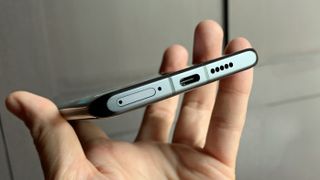
That
band houses the USB-C connector (but sadly no headphone jack, unlike
the P30 ‘normal’), as well as the single, downwards-firing mono speaker.
It feels a bit old-fashioned to not have a stereo speaker setup, but
that’s because there’s no conventional speaker for taking calls – the
screen itself vibrates, using a technology called magnetic levitation.
The
output from said speaker is only fine – it's not the best we've ever
heard, but for a single option it's better than expected in terms of
volume and the clarity of music being pumped out.
The camera array
sits proud from the rear of the phone, pulling in the four sensors
together, which can create a rather lopsided feel when it’s laid on the
table; but the volume and power button sit nicely where the thumb falls
on the right-hand side of the phone.
Camera
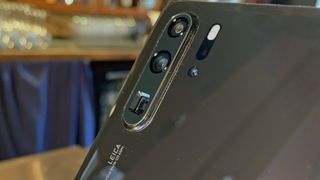
The quad-camera array.
The
big feature Huawei spent so long briefing us on is the new P30 Pro
camera system, which it claims will make us completely rethink
smartphone photography. The main thrust is for the Super Spectrum
Sensor, a 40MP effort that can pull in light at a ridiculously high ISO
and has an f/1.6 lens for quality night footage.
The
SuperSpectrum sensor is the feature Huawei is making the biggest deal
of here: it's replaced each of the green pixels in a standard RGB sensor
with two yellow pixels, so it reckons the sensor will be able to pull
more light and color information as a result, with an enhanced ability
to suck in red and green light.
Combined with Huawei's strong
artificial intelligence (AI) photography smarts, the results should be
impressive. This is flanked by a 5x telephoto camera (a feat achieved by
turning the light coming in 90 degrees inside the phone to give it more
space to reflect the image) as well as a time-of-flight range imaging
sensor (for better background blurring) and an ultra-wide mode, using a
20MP sensor.

Just your average photo, right?
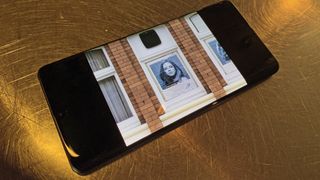
Haha - it was zoomed in. Surprise...
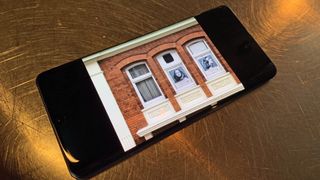
WAIT, MORE ZOOM?
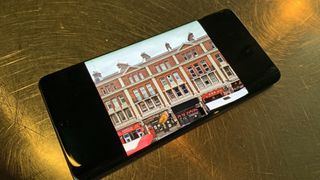
OK, the mind is officially blown. This is from a phone.
Advertisement
The
Huawei P30 Pro also has 10x lossless zoom, claims the brand, thanks to
some inbuilt AI smarts – and it uses that feature to offer a 50x digital
zoom, to do things like take a picture of the moon when it's doing
something pretty, or just have a really close up look at a poster across
the street from a demo area. Just for instance, not saying we're doing
that.
So how does the camera work on the Huawei P30 Pro? Pretty
well. Indoor and outdoor shots look clean, and snap quickly, but do show
that same level of sharpness that Huawei phones seem to deliver - it’s
up to you whether that’s a bold feature or not.
The background
blur on photos looks good too, although the shutter lag was pretty
pronounced – in fact, most photos we took saw the Huawei P30 Pro asking
us to 'hold still' having snapped the shot so it could sharpen the
pictures using its AI mode.

The selfie camera is fine, but 32MP doesn't seem to add a huge amount from a smaller sensor

The depth sensor took a rather long time to work.
The selfie camera is fine, but 32MP doesn't seem to add a huge amount from a smaller sensor
The depth sensor took a rather long time to work.
The
night mode didn't impress massively, but when all you can do in a test
area is wrap yourself in a curtain it's hardly the most scientific of
tests.
However, we did note that the iPhone XS Max
created a night image that was similar to the P30 Pro, so we're not
expecting the new phone to trouble the Google Pixel 3's dominance in the
low-light market.
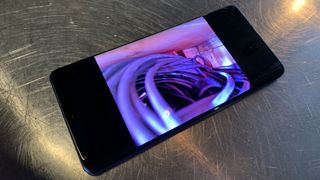
This shot was taken in near darkness and yet enhanced nicely
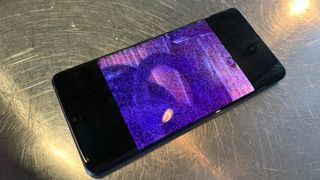
Switching to the f/3.4 zoom lens, you can see the difference in quality
This shot was taken in near darkness and yet enhanced nicely
Advertisement
Switching to the f/3.4 zoom lens, you can see the difference in quality
The selfie camera is powerful – more powerful than is necessary, some might argue – at 32MP and takes a strong enough picture.
There's
smile mode to take a snap, but we found that we had to smile really
widely to have a chance of the feature working – unless we were just
jaded by the press room.
However,
it's in the zoom department that the Huawei P30 Pro really excels. The
5x telephoto zoom and 10x enhanced enlargement both work incredibly well
(though not so much at night), and focusing on a small poster across
the road showed that the 50x zoom actually gave strong, sharp photos
too.
Huawei's AI game is strong at the moment, using internal
smarts to improve the quality of photos, and it's generally done the
same here with aplomb.
In a month or two, when an update lands
you'll even be able to record a video with a small window zooming in on
the action... we can't see why you'd really want to do that though, so
it not being a launch feature isn't the end of the world.
Battery

Advertisement
The
battery life on the Huawei P30 Pro wasn't disclosed by the brand, but
it did unveil an increased power pack inside the phone that offers
4200mAh of power.
Given
we know that Huawei is great at providing battery management features,
we're expecting this internal juice box to keep chugging along nicely
for at least a single day.
However, if the levels are looking a
bit low before you're ready to leave work, the 40W fast charging on the
Huawei P30 Pro means you can get to 70% power in just 30 minutes, which
is pretty incredible.
There's also speedy 15W wireless charging,
and the capability to charge another phone or pair of wirelessly-powered
headphones with some reverse wireless power delivery. Truly, we're
living in the future.
What's it like to use?
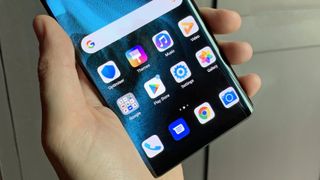
The
Huawei P30 Pro uses EMUI 9.1 a Kirin 980 chipset and an untold amount
of RAM – no, literally, they've not told us what it is. We're assuming
around 8GB, but like the internal storage there's no notion of what's on
offer – although we're expecting storage to start at 128GB for a brand
like Huawei.
The
speed of browsing around the Huawei P30 is much as you’d expect from a
modern smartphone. There's a definite fluidity under the finger, and the
lightning-fast reactions of the connectivity on our test impressed as
we zipped through TechRadar.
EMUI
9.1, the latest version of Huawei’s overlay for Android, is less
onerous than it used to be in days gone by, with the Google integration
for Western versions of this phone on the left screen. There are also
fewer messages popping up everywhere when you’re navigating around, and
combined with the fast innards and clear screen, the Huawei P30 Pro is
adept at whisking you through everyday life tasks.
There
are still confusing and slightly annoying bugs in the system, for
example with the AI video editor, which is supposed to be able to edit
clips for you with no input – we could not find that anywhere in the
camera screen.
It’s also not as fluid as the iPhone XS or the
Samsung Galaxy S10, with some elements of EMUI still feeling a little
too overly complex and offering too many choices and tweaks to make. But
compare it to a phone from Huawei that’s just five years old and you’ll
see a massive change in the way the interface works.
Early verdict
Advertisement
The
Huawei P30 Pro is one of the strongest phones the brand has ever
produced, but the upgrades feel a little more incremental this year.
The
new colors shine nicely, the screen's teardrop notch isn’t too
intrusive, and while the camera system does at least offer something
different, it's still in a minor way.
The speed under the finger
is a nice touch, but we're looking forward to testing the real
differences between the Huawei P30 Pro and last year's Mate 20 Pro, or
the Huawei P20 Pro, to see how much really has changed.


COMMENTS