Huawei’s latest photography flagship What is a hands on review? Image credit: TechRadar Early Verdict The Huaw...
Huawei’s latest photography flagship
What is a hands on review?
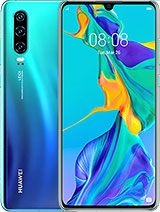
Image credit: TechRadar
Early Verdict
The Huawei P30 has an impressive camera with a range of abilities, and it looks stunning with its design, however it’s not quite as good as the P30 Pro in many ways, and lacks some important features of a high-end phone like wireless charging.For
- Fantastic camera
- Range of vibrant color options
- Cutting-edge chipset
Against
- Inferior to larger Huawei P30 Pro
- Still no wireless charging
- Feels a little heavy
The phone builds on many of the popular features of the Huawei P20, but offers a little bit extra in many ways: it has an extra camera, a bigger battery, and more screen real estate, although it isn’t as much of an upgrade as the Huawei P30 Pro is over the P20 Pro.
We got hands-on with the handset to put its cameras and other features through their paces, and to see if it’s a worthy successor to the Huawei P20.
Huawei P30 release date and price
CLOSE
The P30 was made available to buy at Huawei's launch event on March 26, so you can order it already.
It's
available in one configuration, with 6GB RAM and 128GB internal memory,
which costs €799 / £699 (roughly $900, AU$1,265) – that's a sizeable
step up from Huawei P20 at £599 / AU$999.
Huawei P30 display
There’s
not much point having a great camera on your phone if you don’t have a
high-quality display that does justice to the images it takes, so
there’s a lot riding on the P30’s screen.
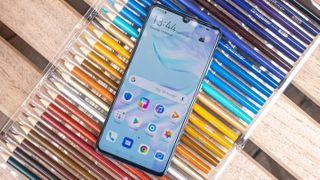
Image credit: TechRadar
The
Huawei P30 comes with a 6.1-inch OLED Full HD+ screen, with a 1920 x
1080 resolution and 19.5:9 aspect ratio. In our experience colors really
popped on the display, with softer tones looking especially vibrant,
while contrast was also good, both in photos we took and in the phone’s
wallpaper and user interface.
The display also houses the
in-screen fingerprint sensor, which Huawei says is its fastest-unlocking
ever, supposedly taking half a second to register your print. It seemed
pretty fast to us, but we’ll have to test how natural it feels to use
over an extended period of time, so we’ll update our findings in our
full review.
Huawei P30 design
The
back of the handset is curved Gorilla Glass, which lends a premium feel
to the phone, although the flat top and bottom seem curiously angular
compared to the rest of the design. The rear camera array does protrude a
little bit too, but it’s nothing compared to the prominent bumps on
some other smartphones.
There’s a volume rocker and power button
on the right side of the device and a USB-C port to the bottom – there’s
also the surprise return of a 3.5mm headphone jack, which the Huawei
P20 was lacking.
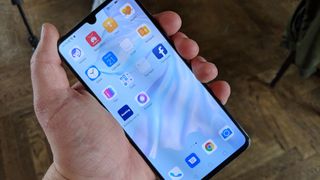
Image credit: TechRadar

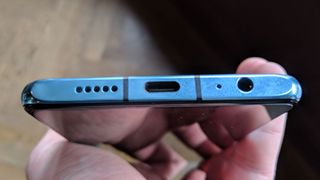
Image credit: TechRadar
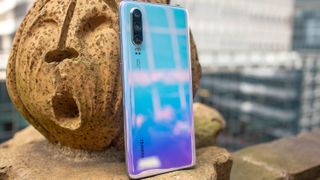
Image credit: TechRadar
Advertisement
Due
to its metal frame, The P30 felt surprisingly heavy to hold despite
actually weighing in at a light 165g. Something else to note is that
it’s only got IP53 protection, which means it won’t be damaged by dust
or splashes of water but nothing more, which is a little disappointing
given the P30 Pro has the far superior IP68 rating for full dust and
waterproofing.
The Huawei P30 is an impressive handset to look at –
provided you pick the right shade. It comes in five colors – Breathing
Crystal and Aurora, which have blue, violet and white gradient designs,
Amber Sunrise which has a red, orange and white gradient pattern, and
rather less impressive white and black designs. We got to see Breathing
Crystal and Aurora, which were rather good looking, and black, which was
not.
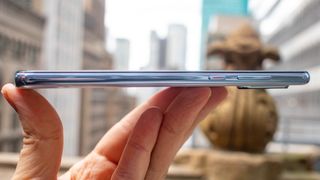
Image credit: TechRadar
Huawei P30 camera
The
camera is the main selling point of the Huawei P30, so of course it was
the first thing we tested. Huawei has made a major change to the way
the main camera on its phones work, in that instead of picking up RGB
(red, green, blue) color as most cameras do, the primary snapper sees
RYYB – the two Ys stand for yellow, and by using this model the phone
can pick up both green and additional red lights, which according to
Huawei means more color and brightness information can be gathered.
This
main camera is the 40MP f/1.6 main Super Spectrum camera, which is
joined by 20MP f/2.2 ultra-wide and 8MP f/2.4 ‘optical periscope’
telephoto cameras. Together this triple rear camera array is meant to
take some amazing pictures – so we put it to the test.
We found
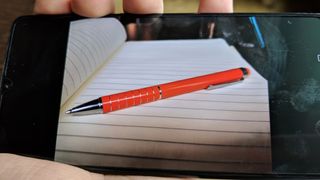
that, as Huawei suggested, the camera was fantastic at picking up
vibrant colors – when tested on orange and blue objects, the colors
popped out from the rest of the surroundings and made for great-looking
pictures. There were different modes which picked up on colors or dulled
them a little bit to fit into the setting, and we found both quite
appropriate for different subjects.
A vibrant orange pen. Image credit: TechRadar

A quickdraw shot. Image credit: TechRadar
The video options. Image credit: TechRadar
Because
more color and brightness information is absorbed through RYYB than
RGB, the phone is also meant to be capable of taking impressive
low-light pictures – a low-light selfie we took looked good, mainly
thanks to the whole-screen flash, but this is definitely something we’ll
be testing more extensively for our full review.
Advertisement
Photos
taken in good light, whether wide shots or close-ups, contained good
levels of detail, and we were impressed by pictures taken – we didn’t
get to try out the camera in a wide selection of settings though, so
when we get our hands on the Huawei P30 for our full review we’ll make
sure to put it through its paces.
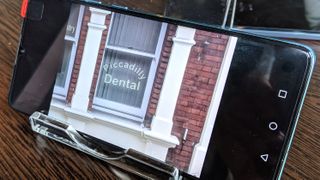
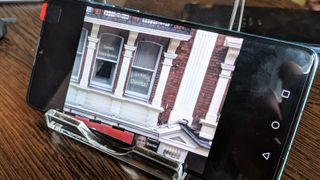
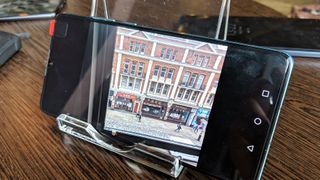
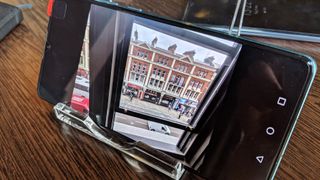
The ‘optical periscope’ lens is
designed to capture high-quality distant pictures, and when we tested
this out we found it worked well, as you can see in the pictures below –
notice how features that aren’t perceptible at 1x zoom retain great
quality even at 30x zoom.

30x zoom. Image credit: TechRadar

15x zoom. Image credit: TechRadar
10x zoom. Image credit: TechRadar
5x zoom. Image credit: TechRadar
1x / standard zoom. Image credit: TechRadar
Ultra-wide shot. Image credit: TechRadar
The
front-facing selfie camera is a whopping 32MP snapper – that’s a lot
more powerful than you’d need for your average social media selfie. It
also took good-looking pictures, and we particularly liked how subtle
the beauty mode filters were – they did a nice, understated job of
smoothing features and thinning the face, although color shifts were a
bit more noticable.
While
the camera performance overall was pretty fantastic, there were some
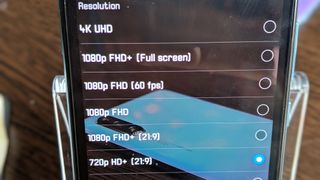
issues we noticed during our time with the handset. Firstly video
filming in 4K was only available in 30fps, whereas at lower resolutions
you could film in 60fps, and since some competing phones can film in 4K
at 60fps, this felt like a major omittance.
Another
camera feature worth mentioning is quickdraw mode, which lets you
quickly take a picture while the phone is off by pressing the
volume-down button twice in quick succession. It’s a great idea in
theory, but it felt a little hard to use – sometimes it wouldn’t take a
picture when we tried, and we found that if you didn’t hold the phone
perfectly still while taking the picture it’d come out rather blurry –
since the mode seems designed for spur-of-the-moment action shots, it
felt rather unintuitive that we’d need to stabilize before taking the
picture.
Huawei P30 battery life
Inside
the Huawei P30 is a 3,650mAh battery, a moderate step up from the
3,400mAh power pack in the Huawei P20, and likely enough for at least a
full day of use given that the EMUI user interface the phone uses is
designed to reduce battery consumption.
The P30 doesn’t support
wireless charging, unlike the P30 Pro, but it can power up using the 40W
SuperCharge fast charger included in the box, which Huawei suggests can
power the phone from 0% to 70% in only half an hour – an incredibly
quick time if true.
Advertisement
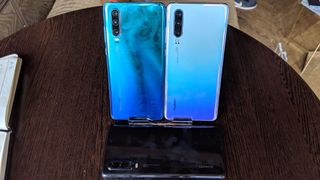
Image credit: TechRadar
Huawei P30 features
The Huawei P30 runs Android 9 Pie,
though laid over the top is Huawei’s own user interface, EMUI, which
redesigns the aesthetics of the phone. We found it rather lurid to look
at – it’s colorful for sure, making the most of the P30’s great screen –
but there was an overwhelming barrage of colors on each page of the
home menu.
Things
were improved somewhat by enabling ‘Simple mode’, which reduced the
number of icons on the screen and made them all much larger – this is a
feature that would be very handy for older users, or people who have
trouble pressing small icons on smartphones.
Inside the phone is the Kirin 980, Huawei’s latest chipset, which we’ve already seen in the Huawei Mate 20 Pro. It’s still a cutting-edge processor despite appearing in last year’s Mate 20 Pro,and is great for multimedia functions, although we didn’t get to test any movies or games in our time with the device.
Early verdict
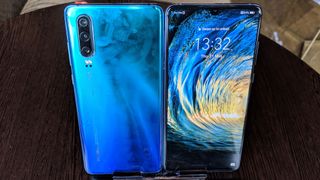
Image credit: TechRadar
If
you’re considering the Huawei P30 it’s likely because of the
photography potential the rear camera array gives you – we’d say we were
blown away by it, but exceptional photo potential is what we’ve come to
expect from the Huawei P series of phones.
The camera felt
powerful and, more importantly, adaptable, as it would take great
pictures in a range of situations, and we’ll be sure to test it with a
range of subjects and in a variety of lighting conditions for our full
review.
The phone did feel a little on the heavy side, though the
bigger battery arguably makes it worth it, and some of the color schemes
look so good that you’ll be too busy admiring your handset to notice
the slight increase in weight.
The biggest reason not to consider
buying the Huawei P30 is that the P30 Pro exists – it has a bigger
screen, a bigger battery and an extra camera but costs a little more. Be
sure to read our Huawei P30 Pro hands-on review for all you need to know about that handset.


COMMENTS